
TL;DR — Quick Summary
- ▸Prediction markets trade binary YES/NO contracts priced between $0.01 and $0.99 — the price equals the market's estimated probability of an event occurring.
- ▸Contracts pay $1.00 if the event happens and $0.00 if it doesn't, so buying YES at $0.60 risks $0.60 to win $0.40.
- ▸You can sell contracts at any time before resolution — you don't have to wait for the event to book a profit or cut a loss.
- ▸Market makers provide liquidity by continuously quoting buy and sell prices; the spread between bid and ask is their compensation.
- ▸Prices aggregate dispersed information through financial incentives — traders with superior knowledge profit by trading, pushing prices toward accurate probabilities.
Prediction markets use a straightforward mechanism: binary contracts that pay $1.00 if an event happens and $0.00 if it does not. But beneath this simplicity lies an elegant system for aggregating information, providing liquidity, and discovering probabilities. This guide explains every component of how prediction markets actually function.
The Binary Contract
Every prediction market starts with a clearly defined question that has an objectively verifiable answer. Examples:
- "Will US GDP growth exceed 2.5% in Q2 2026?"
- "Will the next Supreme Court justice be confirmed before August 2026?"
- "Will the Eagles win Super Bowl LXI?"
For each question, the market offers two types of contracts:
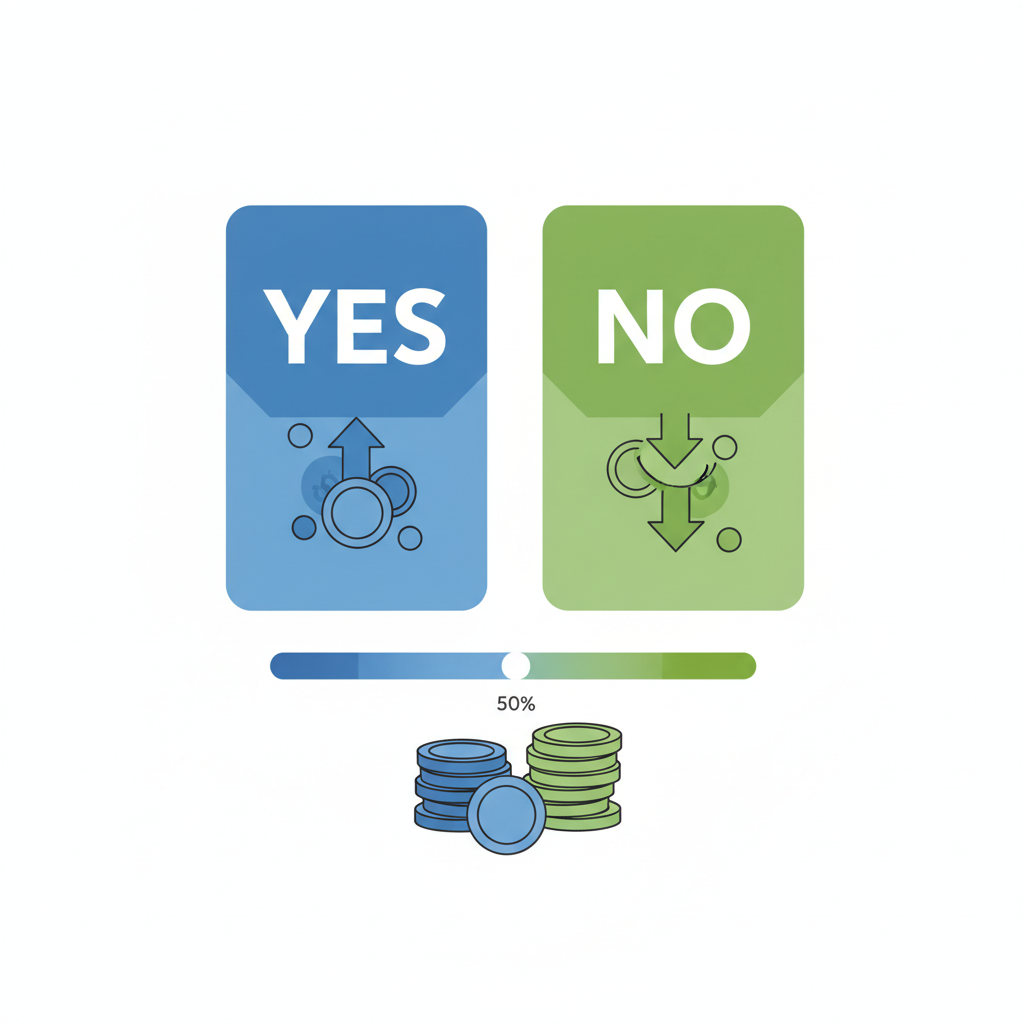
- YES contracts — pay $1.00 if the event occurs, $0.00 if not
- NO contracts — pay $1.00 if the event does not occur, $0.00 if it does
YES and NO contracts are complementary. At any given moment, the price of YES plus the price of NO should equal approximately $1.00 (minus any small spread). If YES trades at $0.62, NO should trade near $0.38.
Cent-Based Pricing
Prediction market contracts trade in cents, ranging from $0.01 to $0.99. This pricing system has two powerful properties:
Direct probability interpretation. A price of $0.73 means the market estimates a 73% probability. No conversion needed — the price is the probability (expressed in cents on the dollar).
Bounded risk. The most you can lose on any contract is what you paid. If you buy YES at $0.73, your maximum loss is $0.73 (if the event does not occur). Your maximum gain is $0.27 (the difference between your purchase price and the $1.00 payout).
This pricing structure makes prediction markets accessible. You always know your maximum risk before you trade, and interpreting the market's forecast requires nothing more than reading the price.
How Trades Work
Trading in a prediction market functions similarly to a stock exchange. There are two primary mechanisms:
Order Book Model
Platforms like Kalshi and Polymarket use an order book, where buyers and sellers post their desired prices:
- A trader posts a limit order: "I want to buy 50 YES contracts at $0.45."
- Another trader posts: "I want to sell 50 YES contracts at $0.45."
- When these orders match, the trade executes.
The order book shows all outstanding buy and sell orders, giving traders transparency into market depth and liquidity.
Market Orders
Most casual traders use market orders — they buy or sell at the best available price. If the current best offer for YES is $0.47, a market buy order fills at $0.47 (or as close as possible depending on available liquidity).
Example Trade
Suppose you believe the Federal Reserve will cut rates in September 2026, and the current YES price is $0.40.
- You buy 100 YES contracts at $0.40 each. Total cost: $40.00.
- If the Fed does cut rates, each contract pays $1.00. You receive $100.00, profiting $60.00.
- If the Fed does not cut rates, each contract pays $0.00. You lose your $40.00.
- If the price rises to $0.70 before the decision, you can sell your 100 contracts for $70.00 — profiting $30.00 without waiting for resolution.
This ability to trade out of positions before the event resolves is one of the most important features of prediction markets. It lets you lock in profits, cut losses, or adjust your view as new information arrives.
Market Makers and Liquidity
A prediction market is only useful if you can actually buy and sell contracts when you want to. This is where market makers come in.
Market makers are traders (often automated) who continuously post buy and sell orders on both sides of the market. A market maker might simultaneously offer to buy YES at $0.44 and sell YES at $0.46. The $0.02 difference is the spread, which represents the market maker's profit for providing liquidity.
Tighter spreads mean lower trading costs and more accurate prices. Major platforms like Kalshi and Polymarket attract professional market makers who compete to offer the tightest spreads, benefiting all traders.
On some platforms, an automated market maker (AMM) replaces human market makers. AMMs use mathematical formulas to set prices based on the ratio of YES and NO contracts purchased. Manifold Markets and some Polymarket markets use AMM models.
Resolution: How Markets Settle
Resolution is the process by which a market determines its outcome and pays winners. It is the most critical aspect of a prediction market's integrity.
Resolution Sources
Each market specifies in advance exactly what data source will determine the outcome:
- Government data — Bureau of Labor Statistics reports, Federal Reserve announcements, Census data
- Official results — Election results certified by state officials, sports league final scores
- Verified reporting — Major wire services (AP, Reuters) for breaking news events
- Scientific data — NOAA for weather events, WHO for health metrics
Resolution Timeline
Most markets resolve shortly after the relevant data becomes available. An election market resolves when the AP calls the race. An economic data market resolves when the official report is published. Some markets have longer resolution windows — a market on annual GDP growth might not resolve until preliminary data is revised.
Edge Cases
Good prediction markets have clear rules for edge cases. What happens if an election is contested? What if economic data is revised after initial release? What if a sporting event is canceled? The market rules (available to all traders before they trade) should specify exactly how these situations are handled.
Interpreting Probabilities
Reading prediction market prices as probabilities is intuitive but has nuances worth understanding:
Calibration. A well-functioning market should be calibrated — events priced at 70% should actually occur about 70% of the time. Studies of major prediction markets show strong calibration across thousands of events.
Movement signals information. When a price jumps from $0.45 to $0.65 in minutes, it means new information has entered the market. Tracking these movements in real time provides valuable intelligence about how events are unfolding.
Prices near extremes require context. A contract at $0.95 does not mean an event is certain — it means the market estimates a 95% chance. The remaining 5% represents genuine uncertainty, tail risks, or information the market might be missing.
Illiquid markets can be misleading. A price of $0.50 on a market with three total traders is far less informative than $0.50 on a market with thousands of traders and millions in volume. Always check market depth and volume before relying on a price as a probability signal.
Multi-Outcome Markets
While the basic YES/NO binary contract is the foundation, many platforms offer multi-outcome markets for events with more than two possible results.
For example, a market on "Which party will win the 2028 presidential election?" might offer contracts for Democrat, Republican, and Independent — each trading at prices that collectively sum to approximately $1.00.
Multi-outcome markets work the same as binary markets: each contract pays $1.00 if its outcome occurs and $0.00 otherwise. The prices across all outcomes represent a probability distribution of the possible results.
Why Prices Converge on Accuracy
The accuracy of prediction markets emerges from a simple incentive: if you know something the market does not, you can profit by trading on it. This creates a constant pull toward accurate pricing:
- If a contract is underpriced (too low relative to the true probability), informed traders buy it, pushing the price up.
- If a contract is overpriced, informed traders sell it, pushing the price down.
This self-correcting mechanism works because traders have real money at stake. The more liquid and active a market, the faster and more precisely it converges on the correct probability. This is why prediction markets have repeatedly outperformed polls, expert panels, and statistical models in forecasting real-world events.
Frequently Asked Questions
See real-time odds and active All contracts right now.